Jade Plant
Crassula ovata
Another Crassula, this one sits right next to Crassula “Gollum” in the garden. Looking at them side by side it’s clear they are very closely related, I can imagine a single mutation caused the leaves of the Jade Plant to curl back upon themselves, and there we have the “gollum”. Evolution in action.
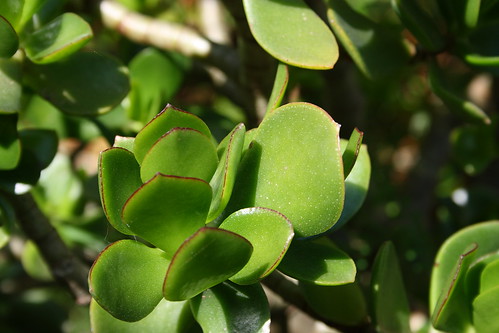
Succulent leaves of the Jade Plant
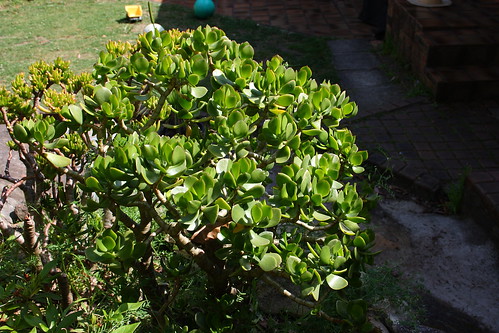
Jade Plant, doing well in shallow sandy soil
Crassula Gollum
Crassula ovata “Gollum”
Crassula Gollum is a South African native that is popular in nurseries. It is a small shrub growing to only 1m tall with thick spongy branches. The leaves are tube-shaped succulent terminating with a red-tipped suction cup like structure at the tips.
The name “Gollum” is in reference to J.R.R. Tolkien’s character from The Hobbit and The Lord of the Rings. I’ve also seen them referred to as “Shrek’s ears”; it’s a pretty good description.
Paperbark Tea Tree
Leptospermum trinervium
“A tall shrub usually to 3m, with a stout trunk and papery flaky bark” – NPOS p.55
Jess and I took a trip down the back to inspect the sewer on the weekend, all looking good, there is no smell now. This Tea Tree was growing on the large flat sandstone outcrop near to the Broadleaf Grass tree. With it’s distinctive flowers and scented leaves I’m certain it’s a tea tree but I’m not so sure about the species. My guess is it’s a Paperbark Tea Tree, it’s flowers, leaves and habitat are consistent. The scientific name “trinervium” is in reference to the 3 prominent veins in each leaf, you can see them in the photo. At the time I took the picture I didn’t take note of it’s distinguishing feature though, it’s bark, I’ll have to go back to check it out.
Ant Hive
These ants have turned up at a few different places around the garden, they seem to occupy a nest for a few months and then move on. They are semi-aggressive and will swarm on you if you stand on their nest or get in their path. They don’t seem to bite though.
The photos are from the 3rd location I’ve seen them, and the first time I’ve seen them swarm in such a dense cluster. There was a lot of movement going on but it seemed ordered, like they were going about a task, some of the ants were carrying white sacks around. I dropped a matchstick next to them to give a bit of scale in the photos and all hell broke loose. The ants swarmed so aggressively that it made a sound, like a soft crunching. The matchstick was swamped. With all the new movement I got a better look deeper into the mound and could see many more white sacks underneath.
Broadleaf Grass-tree
Xanthorrhoea arborea
“A grass tree to 4m tall, with an aerial trunk”– NPOS p.278
Another unique and distinctive plant of the Australian bush. Grass trees have a short stout trunk that is often burned black from previous bush fires terminating with a dense tuft of long grass like leaves radiating from the crown. They are very slow growing at a rate of only 1cm per year, that makes a little 30cm tall plant almost as old as me! They make up for it in life span living up to 600 years old. Every year grass trees sprout a large ( up to 2m ) woody spike from the center of their leafy crown. The top section of the spike is densely covered in small nectar rich flowers.
Bird’s Nest Fern
Asplenium australasicum
“A spectacular epiphyticfern with long, tough, radiating leaves” – NPOS p.306
Great! I’ve found another uncommon fern. It’s hardly fair with the Bird’s nest fern though, it stands out from most other plants in the bush with it’s bright yellow-green fronds and it’s distictive rosette habit.
This one was growing on the edge of a sandstone cliff in the bush out the back.
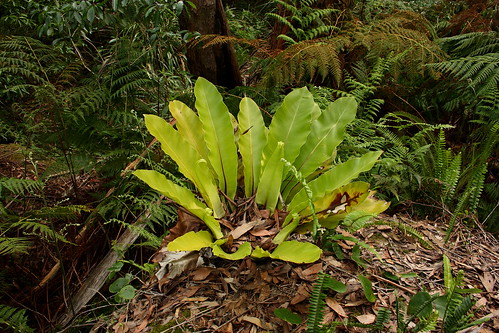
Bird’s Nest Fern growing on sandstone. Found this when I was out the back checking on the sewer leak.
Coral Fern ( G. microphylla )
Gleichenia microphylla
“Habit and Habitat as per G. dicarpa. Uncommon” – NPOS p.314
Yet another Coral Fern! Along with the Pouched Coral Fern (Gleichenia dicarpa) and Gleichenia rupestris, the G. microphylla completes the entire set of coral ferns found in Sydney, according to NPOS anyway.
G. microphylla has features of both G. rupestris and G. dicarpa. It had very fine small fronds that are a deep green colour and convex on the top like G. dicarpa. But on the underside they are flat or just slightly concave like G. rupestris.
Basalt Columns at the Mt Tomar Botanic Gardens
One of the reasons Mt Tomar supports such lush vegetation is that it’s soil derives from the basalt which caps the mountain. Basalt is a very fine grained, dark coloured rock of volcanic origin. It’s abundant in iron, magnesium, calcium and other elements and weathers to form a mineral rich soil that plants love.
I was hoping to see some of the basalt flows but the weather was pretty miserable so we didn’t spend as much time as I would have liked looking about. I did notice the garden walls just below the visitors center were made from presumably local basalt columns. A closer look at the rocks revealed olivene phenocrysts and small vesicles some of which were lined with white crystals, possibly calcite or aragonite?
Day in the Mountains
We took a day trip up to the mountains to visit the Mt Tomar Botanic Gardens and the Zig Zag Railway.
We took the Bells line of road to the Gardens, it was wet and cold but we got the raincoats on and still managed to have a good time. The kids appreciated the run around after being in the car for so long.
The Zig Zag railway was a bit of an adventure. We rode on the steam train, it’s a beautiful engine and the volunteers running it seemed pretty proud. Not long after we departed the train went into a tunnel, it was pitch black in the carriage for a good minute or two. Will was on my lap not not making a peep. When we came back into the light he looked a bit traumatized. It was a leisurely trip to the bottom of the hill with one stop to change direction on the zig. I took Will off between showers to see the steam engine but it was too late for him. I think the dark tunnel, sitting cramped in the carriage and the lack of day sleep took it’s toll and he lost it. He was wailing for mummy, and then when I got him back he kept saying “no moor, no moor, back car”. Then we found out that the steam engine had broken down and we would have to wait for the diesel rail motor to come down and rescue us. Will was really making a scene, we bought the cafe dry of milk, that satisfied him a bit.