Leech
Gnatbobdellida libbata
When it’s been raining we get leeches. Jess spotted this one stuck to the underside of her table. From the description on the Australian Museum Leech page this Leech is classified as a “jawed leech” being in the Gnatbobdellida group:
“The jawed leeches or Gnatbobdellida have jaws armed with teeth with which they bite the host. The blood is prevented from clotting by production of a non-enzymatic secretion called hirudin. The land leech commonly encountered by bushwalkers is included in this group.”
Fishbone Fern
Nephrolepis cordifolia
“A fern with narrow erect fronds, often spreading over large areas.” – NPOS p.310
Everyone except me ( neighbors, mum ) seemed to know all about the fishbone fern. Even though it’s a native to Australia where it naturally occurs in Queensland and Northern NSW, it’s considered a weed in Sydney. It does tend to take over parts of the garden, especially places I’ve cleared of other weeds.
The plant sketches in NPOS are usually very good, but for the Fishbone Fern I didn’t think it looked like the plant I saw. I checked a few other sources to make sure I had the right plant.
Prickly Moses
Acacia ulicifolia
“A wiry, prickly shrub to about 1.5m high…” – NPOS – p.67
I didn’t know what this was when I took the photo, it stood out because there appeared to be two very different types of flower growing on the same plant. It turned out to be two similar looking plants that were intertwined. I still don’t know what the 2nd plant is. It’s a Heathy Parrot Pea
After seeing a plaque at the wildflower garden I’m pretty sure this is a Prickly Moses, one of the many species of Wattle.
Ku-ring-gai Wildflower Garden – Sep 2011
I’ve fallen into a pattern of going out on an expedition on the weekend then posting the photos and descriptions during the week. This has worked well so far, starting today I’m going to post about the trips too.
The whole family went to visit Ku-ring-gai Wildflower Garden on Sunday. The gardens are really just a very well maintained collection of bush tracks next to Ku-ring-gai Chase National Park. There is a great play area for the kids, complete with semi tame wallabies that hop around. The main track we’ve been taking is sealed and easy to navigate with strollers and bikes / scooters. Many of the plants beside the track are labeled with common and scientific name, sometimes with a short description too. Perfect if you’re trying to learn to identify what you’re looking at!
Sydney Rock Orchid
Dendrobium speciosum
“A spectacular epiphytic orchid with stout swollen pseudobulbs, found in clumps on cliffs and rock ledges…” - NPOS p.262
Sometimes called the rock orchid or rock lily. There are a few of these on the rocks in the front yard (where the picture was taken). In some places they are competing with some Agapanthus which I will remove at some stage.
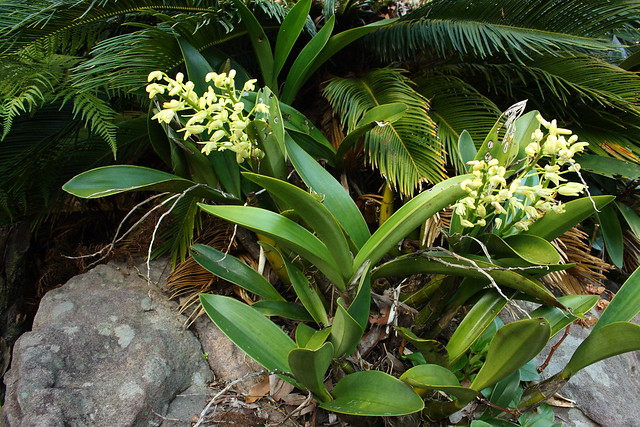
Sydney Rock Orchid in flower from the front yard
Pine-leaf Geebung
Persoonia pinifolia
“A spreading shrub 2-4m high, with crowded pine like leaves” NPOS p.103
The Pine-leaf Geebung is pretty easy to identify when in flower or fruit. The fruit is edible once it turns purple, but whenever I’ve tried some they’ve been strongly astringent, not a good meal!
Don’t miss Banjo Paterson’s “The Geebung Polo Club”
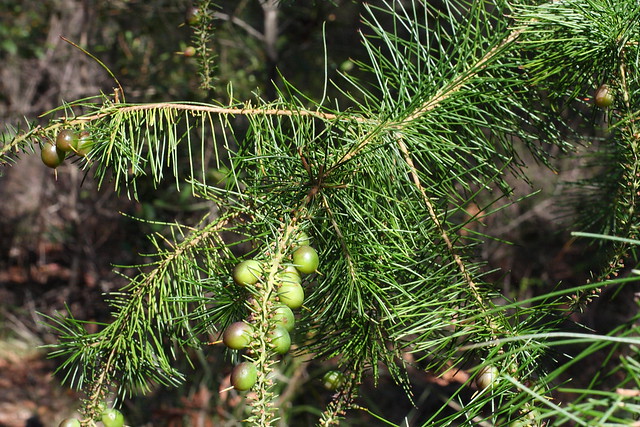
Pine-leaf Geebung in fruit. You can supposedly eat the fruit once it has turned purple
Swamp Wallaby
Wallabia bicolor
I’m still amazed that there can be wallabies in backyards this close to the city. Growing up around here I never saw a wallaby in the bush, or even heard of anyone seeing one. I wonder what’s brought them back.
They seem to hang about near the house much more during winter and spring, they’re often here in the morning having breakfast, and sometimes stay for the day lounging in the sun.
Flannel Leaf
Astrotricha floccosa
After some more searching I think this is a Tobacco Bush. The leaves are narrower than some other photos out there, everything else seems to match though. Julia’s comment I also think this is a Flannel leaf! When searching through Google images I still think tobacco bush (Solanum mauritianum), and the native flannel leaf (Austrotricha floccosa) are remarkably similar looking but the Flannel leafs description of a shrub 2 - 4m tall matches more closely with what I saw.
What Plant is This?
Jess and I went for a walk to the Middle Harbour Creek stepping stone crossing at the intersection of Bungaroo and Governor Phillip tracks. This plant was sprouting up all over the place by the side of the river.
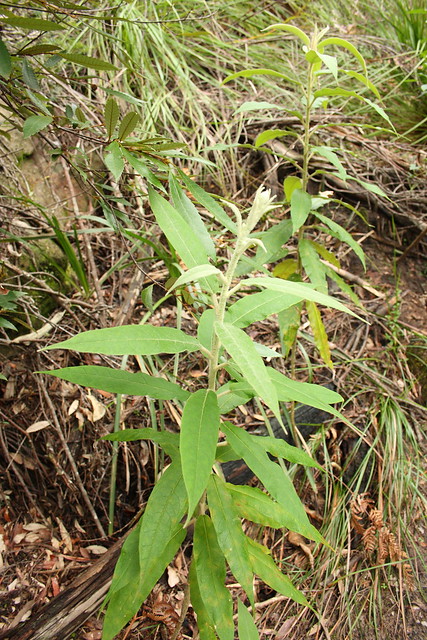
It doesn’t look like a native but who knows, I’ll update this page when I find out what it is.
[[update]] It’s a Tobacco Bush Flannel Leaf