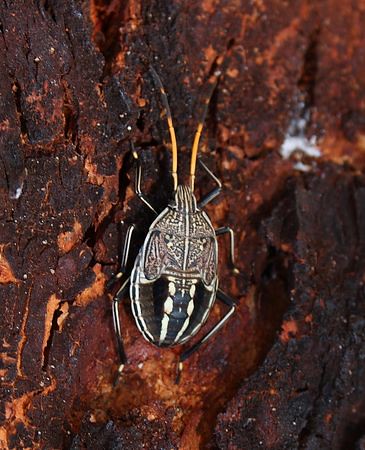
Unknown Bugs
September 29, 2011
[update Nov-2015] Finally worked out that these are Gum Tree Shield Bugs
These bugs were on a tree in the wildflower gardens. I’ve been trying to work out what they are. What bug is that looks comprehensive and has a good bug identification tool but I’ve been unsuccessful so far.
They’re quite distinctive looking, part of my problem is describing it in a way that someone who knows this bug would write about it. I found out entomology is very specialized and has a whole language of it’s own!
By Joe Lipson
read more
Gymea Lily
September 28, 2011
Doryanthus excelsa
“A colossal leafy herb with stiff flowering stem 3-4m tall bearing a dense cluster of large red flowers” – NPOS p.226
The Gymea lily is exotic looking with it’s huge sword like leaves radiating from it’s base and the towering stem with large flower on top. It’s a popular garden plant, and impressive that it’s naturally occurring in the area. I can’t remember every having seen one outside of peoples gardens though.
By Joe Lipson
read more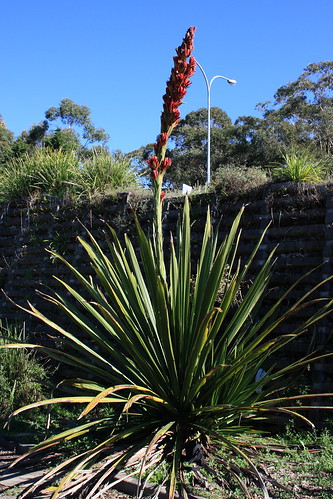
Giant Spear Lily ( Gymea Lily )
September 25, 2011
Doryanthes palmeri
“[The] Giant Spear Lily is a large, succulent herb which grows as a rosette. It’s hairless leaves are sword–shaped, and up to 3 m long and 20 cm wide” – Atlas of Living Australia
Gymea Lilies are spectacular, especially when they are in flower. The plant is on a colossal scale, sword shaped leaved up to 2m long radiate from a point in the ground. When flowering they grow a thick spear up to 4m long from the center of the leaves with large vivid red flowers perched at the top.
By Joe Lipson
read more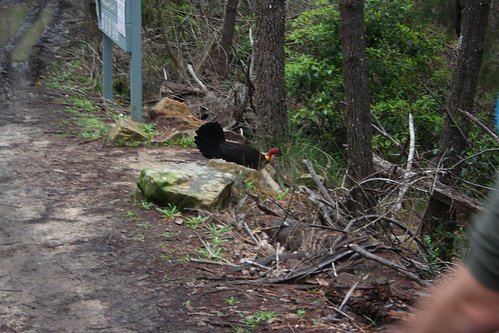
Brush Turkey
September 22, 2011
Alectura lathami
Like the Swamp Wallaby the Brush Turkey is another animal that I never saw around here growing up, but has recently come back to the area. Brush Tukeys were once common around Sydney but were more or less wiped out during the depression when people found them to be an easy to catch dinner. It’s only been in the last 10 years or so that they are making a come back.
By Joe Lipson
read more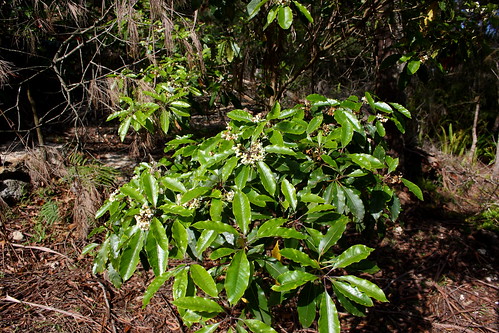
Sweet Pittosporum
September 21, 2011
Pittosporum undulatum
“Originally a scattered inhabitant of shady, rainforest gullies, it is highly opportunistic and now aggressively colonises almost any moist, shady location..” – NPOS p.196
Like the Fishbone Fern the sweet Pittosporum is a native plant that is now often considered a weed in urban bushland. Although the Sweet Pittosporum is different in that it’s also naturally found in the Sydney area.
We have a few of these in the front and back yard. It’s a small tree, the leaves are vivid green, shiny and have wavy margins, which is where is scientific name undulatum comes from. It’s meant to have a strong sweet smell when in flower. I’ve had a blocked nose for the week though and have not noticed it. The seeds are edible and were ground for food by Aboriginies.
By Joe Lipson
read more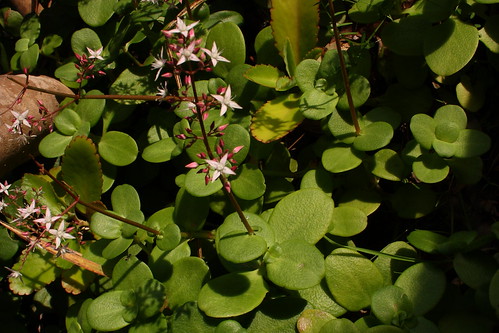
Pitted Crassula
September 20, 2011
Crassula multicava
Another breakout that has colonized large parts of the front garden. The Pitted Crassula, also know as Cape Province Pygmy Weed is originally from South Africa and is considered by some to be a weed over here. It’s a small ground hugging plant with light green thick succulent leaves. The leaves are covered in small pitts or divots, flowers are white to light pink and look like a 4 pronged star.
By Joe Lipson
read more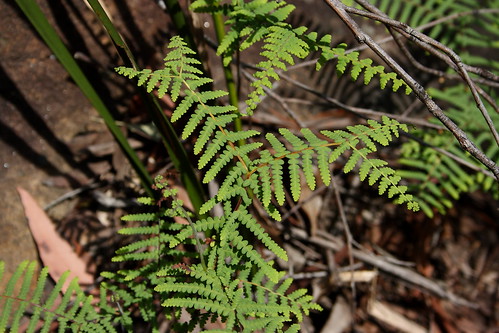
Coral Fern ( G. rupestris )
September 19, 2011
Gleichenia rupestris
This coral fern was helpfully marked on the Mueller track in the wildflower gardens. It was growing on sandstone near the base of a small cliff. The species wasn’t indicated, but from the description in NPOS I think it’s Gleichenia rupestris. The fronds are flat on the underside and are larger and flatter than the pouched coral fern, the stalks are hairless.
By Joe Lipson
read more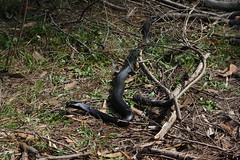
Mueller Track at the Wildflower Garden
September 18, 2011
Jess, Will and I went on another trip to the wildflower gardens. Kelly stayed at home with Tom to rest and recover from a cold. The rest of us had the worst of it yesterday.
We went in via the playground then on to explore the Mueller track for the first time. It was the first hot day of the season, was meant to be 28 and it did feel like it. Only a few meters out of the carpark we came across a large red bellied black snake by the side of the track enjoying the heat. We got a good close look, it didn’t seem too worried by us.
By Joe Lipson
read more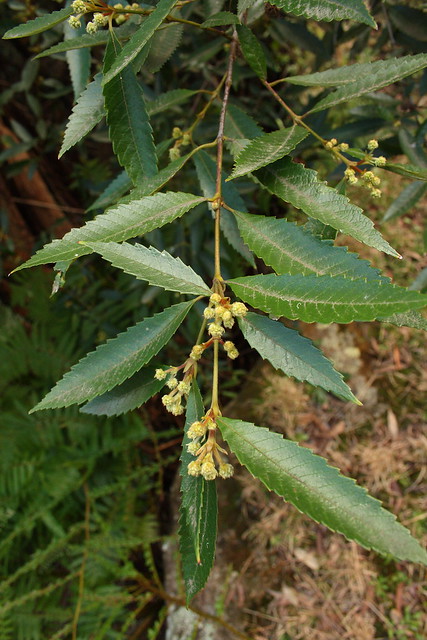
Black Wattle
September 15, 2011
Callicoma serratifolia
“A large spreading shrub ( usually about 4-5m high but can be 10-15m high ) with wattle like flowers” – NPOS p.157
Black wattle is not an Acacia so it’s not a true wattle. It got the name because it’s flowers are similar to the flowers common to wattle trees. The first wattle and daub houses in the colony of NSW were made from the branches and timber of the black wattle.
By Joe Lipson
read more