Sydney’s Changing Climate
November 5, 2013
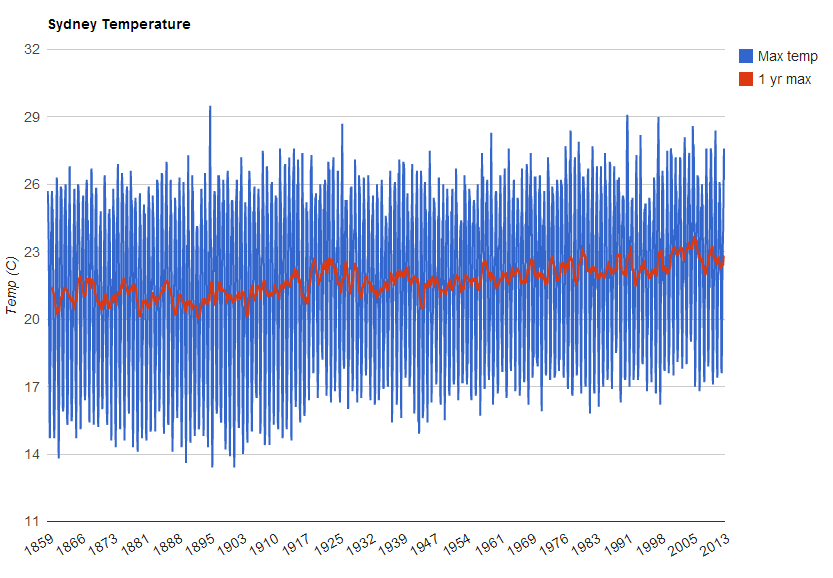
Besides the boring old weather the Bureau of Meteorology website has a lot of pretty cool stuff. Something I’ve been digging into lately is their climate data. Depending on the weather station you can find rainfall, maximum and minimum temperatures going back over 150 years. I’ve used their temperature data for the Observatory Hill station in Sydney to make a graph over time, I’ve also calculated moving averages over various time periods. It’s turned out some pretty interesting results. There’s a clear warming trend since the early 1900’s for maximum temps and around the mid 1940’s for minimums, but it’s not all smooth, there have been some ups and downs that have lasted over 10 years. Click through to the interactive graph and have a play, you can turn the various data series on and off to compare. You have to be a bit patient, it can take a few seconds after you click to send through the new data points and graph them.
By Joe Lipson
read more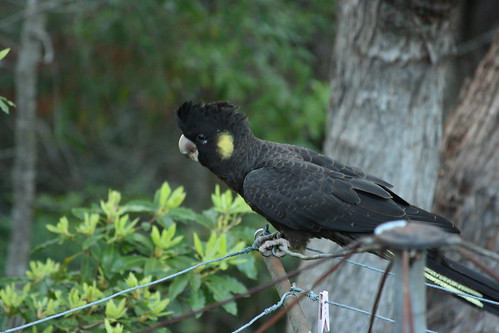
Black Cockies
August 27, 2013
Calyptorhynchus funereus
I used to think that a black cockie was a black cockie, it turns out that the name is a general descriptive term for several species of cockatoos with black colouring. The cockies that visit my yard are Yellow tailed black cockatoos. For the last few years they’ve been turning up for just 1 day, chowing down on Banksia flowers, gnawing off many small branches, and then flying out not to be seen for another year. Yellow tailed black cockatoos are big, noticeably bigger than the Sulphur-crested Cockatoos that are here year round. They have black feathers all over with a yellow patch on the cheek and the tail.
By Joe Lipson
read more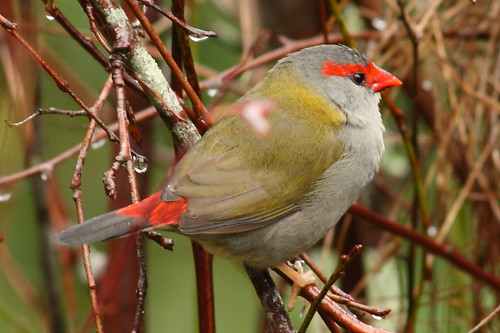
Red-browed Finch
August 5, 2013
Neochmia temporalis
The Red-browed Finch is a spot on name for these guys, the other thing to add is they are small and they are fast! Red-browed finches enjoy hanging out in the garden near to the ground where there’s good cover from scrub and small trees. I’ve not seen them flying in the sky or anywhere in the open where there’s no cover. There’s a prunus tree in the backyard that they build a nest or 3 every year. Their nests are made from twigs, tightly woven into an enclosed ball shape with one small doorway. Red-browed Finches are a common bird that are found up the entire east coast of Australia. They are found in grassy areas interspersed with dense understorey vegetation, often along creek lines.
By Joe Lipson
read more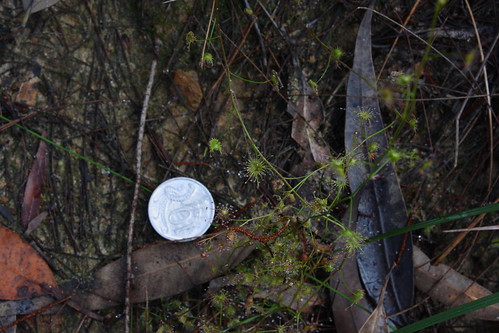
Pale Sundew – Another Sundew
July 30, 2013
Drosera peltata
“stalked semicircular leaves on a slim stem to about 20cm high” - NPOS p. 163
Funny how you can pass something a hundred times and never notice it. A few of these pale sundews were growing in exactly the same spot as a bunch of common sundews I’d known about and been passing for months. Just like the common sundew the pale sundew grows on damp clay or sandy soil and makes up for poor nutrients by capturing small insects with sticky fluid excreted from it’s leaves. You can see by the 10c coin that they are small, and there’s not much bulk to them so easy to miss I suppose.
By Joe Lipson
read more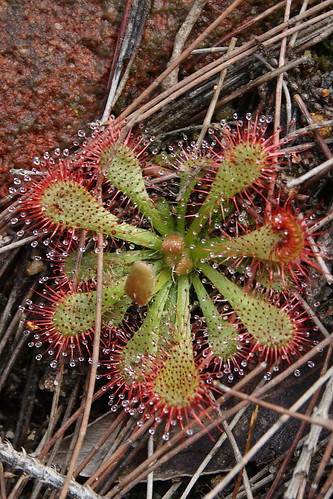
Common Sundew
March 10, 2013
Drosera spatulata
“A small rosette herb, about 30mm wide.” NPOS p.164
The Common Sundew is a small ground herb, it has remarkable leaves that are covered in coarse red hairs and tipped with a clear sticky fluid. When small insects get stuck the leaves roll up and the insect in consumed. In this way the Sundew is able to supplement it’s diet by providing nitrogen that is lacking in sandy soils. The Sundew is a small plant and easy to miss unless you are really looking. They are not rare but I’ve only found them growing in a few areas on sandy / clayey soil that is wet year round.
By Joe Lipson
read more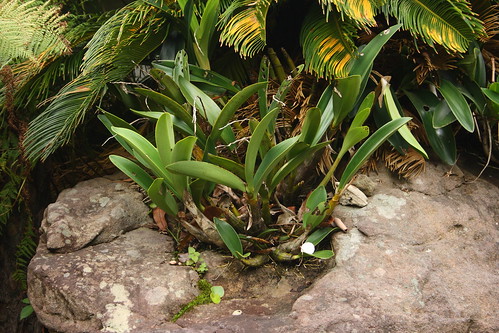
Rock Orchid
March 4, 2013
Dendrobium speciosum
“A spectacular epiphytic orchid with stout swollen pseudobulbs..” – NPOS p.262
While I’m on the topic of orchids these Rock Orchids grow on several rocks in the front yard. Like the Tongue Orchid they too are hardy plants ( you would have to be to survive in my garden ! ) and survive hot dry summers perched on the rocks with no watering. They are supposedly rare in the Sydney area so I wonder if they were planted by a previous owner.
By Joe Lipson
read more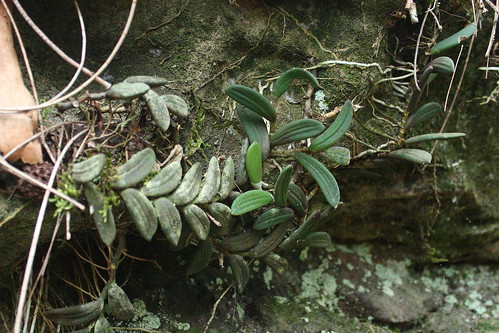
Tongue Orchid
March 1, 2013
Dendrobium linguiforme
“A remarkably hardy little rock-orchid, common on exposed sandstone cliffs and also in moist mossy gullies” – NPOS p.262
Tom has not been sleeping well the last few weeks, late to bed and early to rise. We went down to the river together for an early walk which gave me the chance to finally take a picture of this tongue orchid. They are meant to be a common plant but I can’t recall seeing another one in the area. This particular one is growing on a sandstone boulder in a gully near a small creek. It really must be a hardy plant to be able to survive clinging to bare rock. In dry times the furrows in the thick leaves deepen and they turn a purple colour. When the rain comes the leaves puff up and turn green. We’ve had a lot of rain in the last month hence the green colour of the leaves in the photo.
By Joe Lipson
read more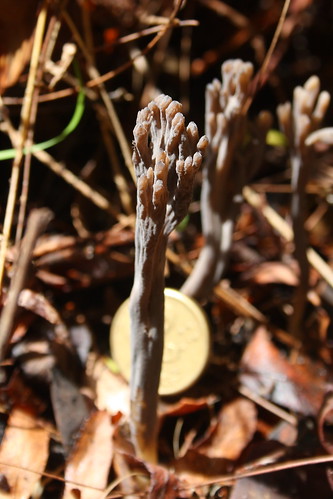
Coral Fungus
February 24, 2013
Coral Fungus
This unusual looking fungus was growing in the back yard on a rotting tree stump in amongst some dense Fishbone fern. It’s another thing in the backyard that I’ve never noticed before, or more likely have seen and just forgotten.
After a bit of searching around on Google images I think it’s a type of coral fungus.
Coral Fungus $2 AUD for scale
Coral Fungus close up
By Joe Lipson
read more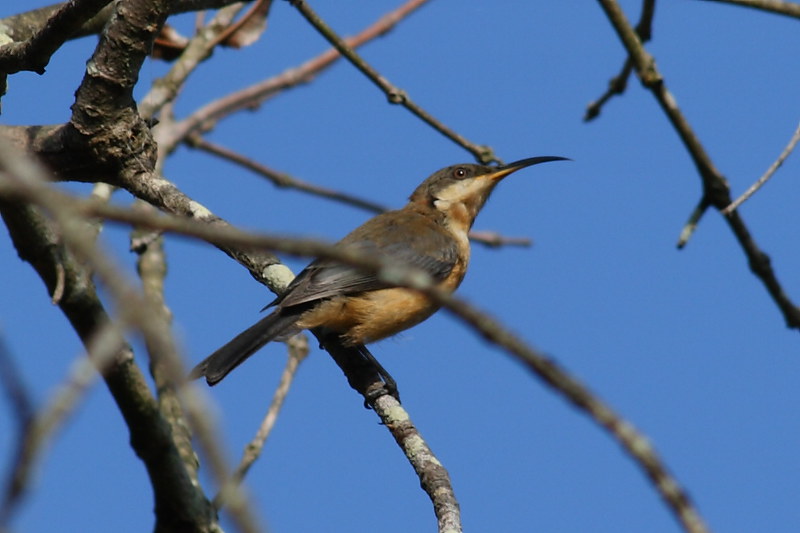
Eastern Spinebill
January 17, 2013
Acanthorhynchus tenuirostris
I’m pretty sure this is an Eastern Spinebill, it was sitting in the Macadamia tree in the front yard. I’d not head of this bird before and can’t say I remember ever seeing them around.
The Eastern Spinebill is a small bird, about 13cm – 16cm, it can be recognized by it’s long fine down curved beak. The bird in the photo is a female, males have more distinctive and defined colourings of black, white and tan across their body. They are found on much of the east and southeast coast of Australia and also throughout Tasmania.
By Joe Lipson
read more