Spitfire Caterpillar
September 7, 2015
Perga dorsalis
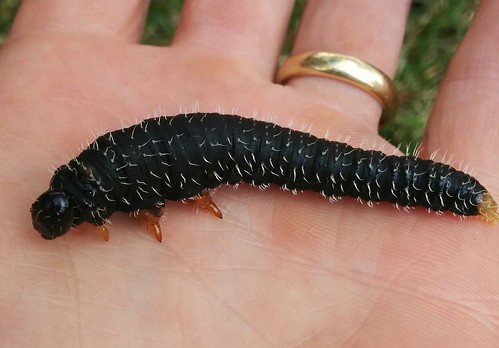
First up it’s not a caterpillar, it totally looks like one but it’s not! It took a bit of searching to find it’s actually a Steel Blue Sawfly Larvae. Sawflys are large flying insects that are closely related to wasps. Caterpillars on the other hand are the larvae of butterflies and moths. The Steel Blue Sawfly Larvae is commonly known as a “spitfire” or “spitfire caterpillar”.
A sawfly larvae, AKA spitfire, on my hand. Just after the photo it had a big “spit” of yucky yellow fluid onto my hand
By Joe Lipson
read more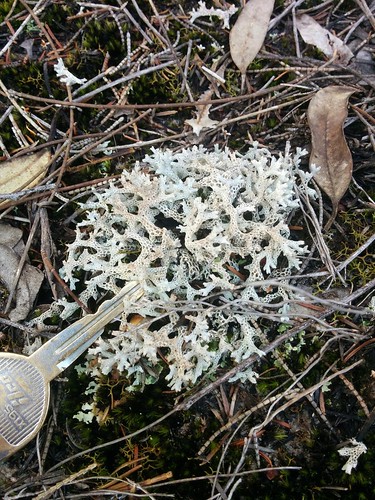
Coral Lichen
August 30, 2015
Cladia retipora
A few months ago I took the boys for a ride on the center track in Ku-ring-gai National Park. We all had a great time on the way out and a good play on a large sandstone pavement that crosses the path. They were pretty tired by then, the trip back wasn’t as happy! Even though it’s quite close to the local bush there were many plants that I’ve not seen in Garigal. I found something that was completely unfamiliar, have a look at the photo:
By Joe Lipson
read more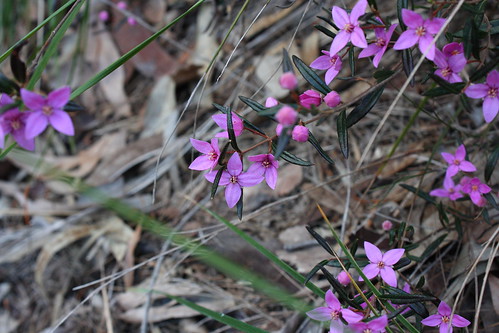
Sydney Boronia
August 20, 2015
Boronia ledifolia
“The hardiest and also the earliest flowering of the local species” – NPOS p.116
Tom was the only one that had been home all Sunday, by late afternoon he had a bad case of cabin fever and demanded to go on a bushwalk, and one he’d never been on before. We took a path that joins the usual route, but past where we normally finish, then ended up doing the river loop in reverse. A few different wild flowers were in bloom, it really felt like the start of spring. I took pictures of these small purple flowers, I had a hunch they were a species of Boronia and I was right. Boronia is another one of those plants that everyone seems to be familiar with except me. This particular one is a Boronia ledifolia, commonly known as Sydney Boronia. It’s a common plant, abundant in heath and woodland and also the earliest flowering of the local Boronias. The plant itself is small only growing to 1m in height. it’s flowers are four petalled and a sticking pink in colour, approximately 4cm across. Leaves are thin with a waxy shine, deep green in colour with pots and recurved margins.
By Joe Lipson
read moreBlack Cockies Make Their Visit
August 14, 2015
It happens every year around this time, this year it was yesterday, August 13th. They were in the Banksia out the back but had gone by the time I got the camera. They’re usually just here for a just one day per year, I’ve not been able to find any information on their migration habits, or even if they migrate at all. But where do they go for the rest of the year! Here they were last year.
By Joe Lipson
read more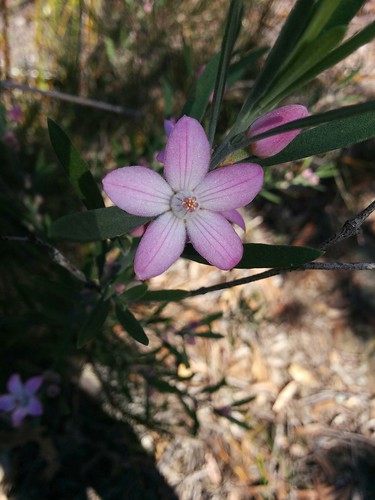
Pink Wax Flower
August 1, 2015
Eriostemon australasius
“Easily recognized by it’s large pink flowers and thick grey green foliage” - NPOS p.118
After having come home from the boys soccer to an empty house without keys there was only one thing to do, get the boys on their bikes and head down the bush! The weather was warm with the first hints of spring, a number of flowers had started to come out too. I didn’t have my camera with me so I took these photos with my phone, I’m still so impressed at how clearly they come out with such a small lense and sensor. This plant took me a while to identify, in NPOS it looks similar to Crowea saligna or Crowea exalata, but the flowers are not quite as depicted in the book. In the end I’m pretty sure it’s a Eriostemon australasius also known as the Pink Wax Flower. Pink Wax Flowers are common in heath and woodlands on sandstone plateaus. They are a small shrub growing to about 1.5m They have leathery leaves that are narrow, 1cm, and long, 8cm or so. The flowers are numerous and striking, large and pink with 5 petals.
By Joe Lipson
read more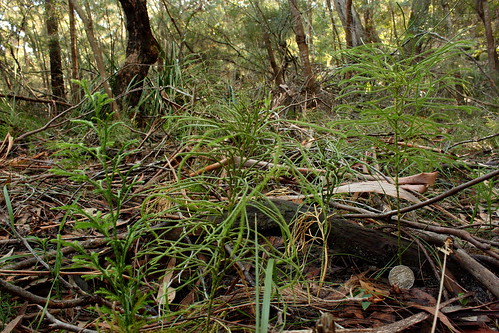
Bushy Clubmoss
July 5, 2015
Lycopodium deuterodensum
“A small erect plant, resembling a miniature pine tree” – NPOS p. 304
Clubmosses are ancient plants, the oldest fossils dating from the Devonian period 395 Million years ago, 150 Million years before the dinosaurs! I came across this grove of bushy clubmoss at the flat bottom of the small gully behind our house while searching for the dog that had got away again. Bushy clubmoss is supposedly fairly common in wet sandy soil, but this is the first time I recall seeing them. NPOS lists the common name of Lycopodium deuterodensum as “Mountain Clubmoss”, but searching online “Bushy clubmoss” seems to be used more often. Bushy Clubmoss is small, usually 20-30cm tall, although they are known to grow larger. They often have a straight central stem where branchlets covered by small scaly leaves sprout from, somewhat resembling miniature pine trees. They are thought to be structurally similar to the earliest vascular plants. They really do look like they are from another time.
By Joe Lipson
read more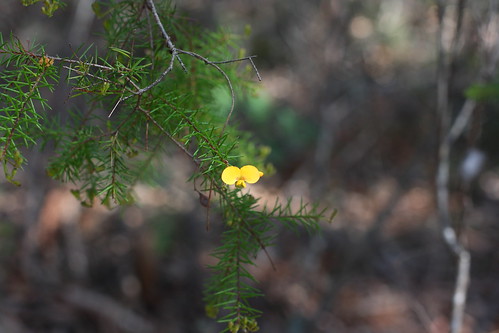
Healthy Parrot Pea
June 28, 2015
Dillwynia retorta
“A small, spreading shrub to 1m high”. – NPOS p.78 While revisiting the Prickly Moses I was reminded of a plant that I’d been unable to identify at the time. After some searching I think it’s a Healthy Parrot Pea, Dillwynia retorta. I wish I’d kept notes on exactly where it was found but It’s clear it’s a pea of some sort from the non symmetrical yellow flowers. The short prickly leaves narrow it down, but it’s the twist in the leaves that is observable is some parts of the photo that make me think it’s the Healthy Parrot Pea.
By Joe Lipson
read more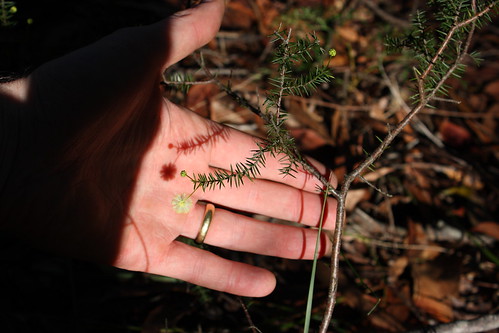
Another Prickly Moses
June 28, 2015
I’ve already done a post on the Prickly Moses, but wanted to post a picture of one that I came across today while looking at clubmosses.
A baby Prickly Moses
By Joe Lipson
read more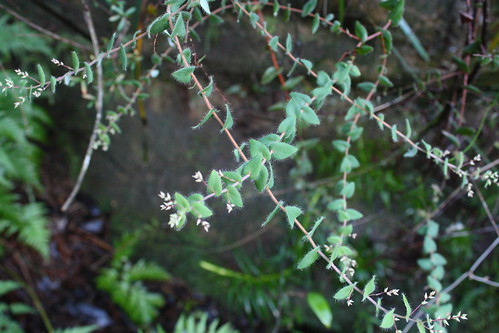
Beard-heath
June 22, 2015
Leucopogon amplexicaulis
“A small weak shrub to 1m tall with distinctive leaves” - NPOS p.108
Will had “B.O.B” the classroom mascot for the weekend so we decided to take him down to the river to throw some stones! It had been raining for pretty much the whole previous week and the ground was soggy, and being the winter solstice it was dim and cold. I spotted this small plant growing on a damp sandstone ledge near where of Allan Small creek meets Middle Harbour river. As usual I couldn’t identify it but figured the distinctive hairy leaves would give me a good chance of being able to look it up. I’m pretty confident it’s a Leucopogon amplexicaulis, commonly known as Beard-heath. Beard heath is a small plant, up to 1m in height, made up of sparse scrambling stems with leaves attached directly. The leaves are 30 – 90mm long, heart shaped and have a distinctive “beard” of white hairs around their margins. Flowing time is spring and winter, the specimen pictured was just beginning to flower. Fruiting is September to December and apparently it’s edible, I’ll be sampling some when it’s ready!
By Joe Lipson
read more