Peewee (Magpie lark)
Grallina cyanoleuca
These medium sized black and white birds were hanging about in the trees out the back, it’s yet another species that I couldn’t identify! By the time I got the camera they were gone. Luckily they returned the next day, this time I was ready.
I’ve mentioned the method I use to identify birds and other plants and animals before but wanted to say it again as I find it really effective. First try to take a photo to closely study the features of the animal, then go to Google image search and type in a visual description with a location. When an image matches check it out, all you need is a name then you’re set. This is how I identified the Peewee. “black and white bird australia” brought up exactly what I’d seen.
Camouflaged Gecko
I was moving an old pile of timber out in the back yard over the weekend, hiding in amongst it were 2 Broad Tailed Geckos. I only actually saw one, which had dropped it tail and run off. I knew there was at least one other as there was a second tail writhing about on the ground. The tails moved as though they were alive, made me wonder if they can drop their tails at will as a diversion when they sense they are about to be preyed upon.
I’d placed my jacket on the ground while I was working, when I picked it up a few hours later this guy fell out! Geckos look cool and I always like to see them, I was extra impressed with how effective it was camouflaged against the natural sandstone.

Silvereye
Zosterops lateralis
Another common bird that I’ve only recently identified in the backyard. The Silvereye gets it’s name from the distinct patch of white around it’s eyes. It’s a small bird, only 11cm – 13cm in length, it moves about quickly making it hard to spot and identify. Silvereye live on the coast and adjacent inland areas of almost all of the country, they’re also found throughout New Zealand and southwest Pacific islands including Lord Howe, Fiji and Vanuatu.
New Holland Honeyeater
Phylidonyris novaehollandiae
Another ( former ) unknown bird in the yard. It’s a New Holland honeyeater, a not uncommon bird that’s distribution stretches from the southern Queensland coast, all the way down the east coast, throughout Tasmania, then westwards following the mainland coast wrapping up a few hundred km north of Perth. They’re small birds reaching a maximum size of 20cm. This one was hard to photograph, it kept moving about, not staying still for long at all.
Saunder’s Case Moth Cocoon
Metura elongatus
This cocoon was on a post at the start of the Little Blue Gum Creek walk. It’s large, about 15cm long, with sticks woven into the sides. I remember seeing many like this when I was growing up but had never known what animal made them.
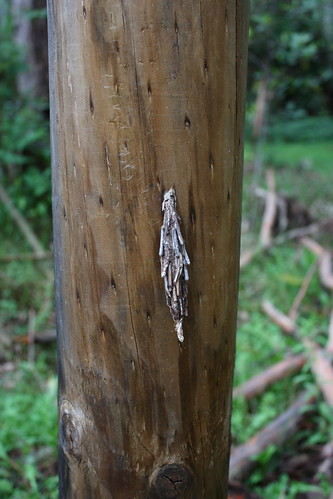
Saunder’s Case Moth Cocoon at the start of the Little Blue Gum Creek boardwalk.
A quick search pointed to it being a Saunder’s Case Moth cocoon. During their caterpillar phase case moths make their cocoons out of silk, most species attach sticks, leaves or other debree as camouflage. Each species had a distinct type of cocoon, but they are also constrained by available materials so even within a single species cases can vary in materials and appearance.
Gooseneck Barnacles
[update] – The source of the pumice is likely to be from the 2012 Havre Seamount eruption 800km NE of New Zealand. The eruption of this undersea volcano produced floating rafts of pumice estimated to be up 26,000 km²! Thanks for the info Matt!
These shelled creatures are known as Gooseneck barnacles. They were covering the recently washed up pumice on Elizabeth beach. Many of them were still alive, you could see them extending their fan like fronds.
Male Eastern Spinebill
I’ve done a previous post on the Eastern Spinebill , I just wanted to share a new photo, this time of a male. As often seems to be the case in nature the male is more striking than the female, I guess they need to impress, and it’s not like they can buy a fancy car.
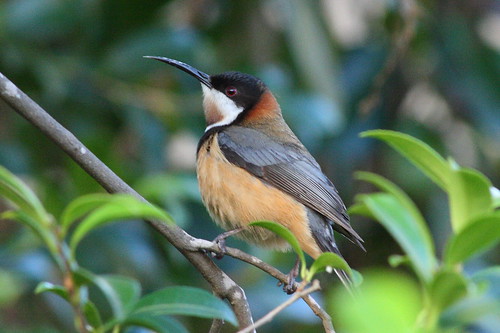
Male Eastern Spinebill – what a hansom devil
King Parrot
Alisterus scapularis
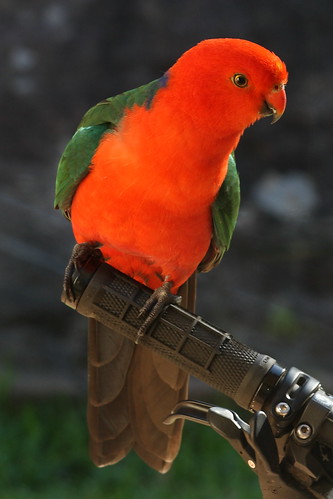
The King Parrot is another common bird in the the area that I was oblivious to until recently. It was my next door neighbor that pointed them out to me. I reckon the name suits, they are a medium to large bird, 43cm in length, males have a striking red colouring over their head, breast and underside and have deep green wings. Females are the same size with similar colouring but with green heads.
King Parrots are frequent visitors to our yard, I had one land on my hand to eat some birdseed last week.
Ant Fight! ( Sugar ant v. Black ants )
Camponotus consobrinus (sugar) and Ochetellus glaber (black)
I was taking the 2 boys for a walk down to the river on the weekend when we came across a lone sugar ant in the middle of a swarm of about 20 tiny black ants on a patch of exposed sandstone. At first it looked like the small black ants were teaming up to attack the sugar ant, but after watching them for a while it was clear the sugar ant was not trying to get away, and was in fact chasing and attacking the much smaller black ants!